What's the Best Suit Cut for a Petite Executive?
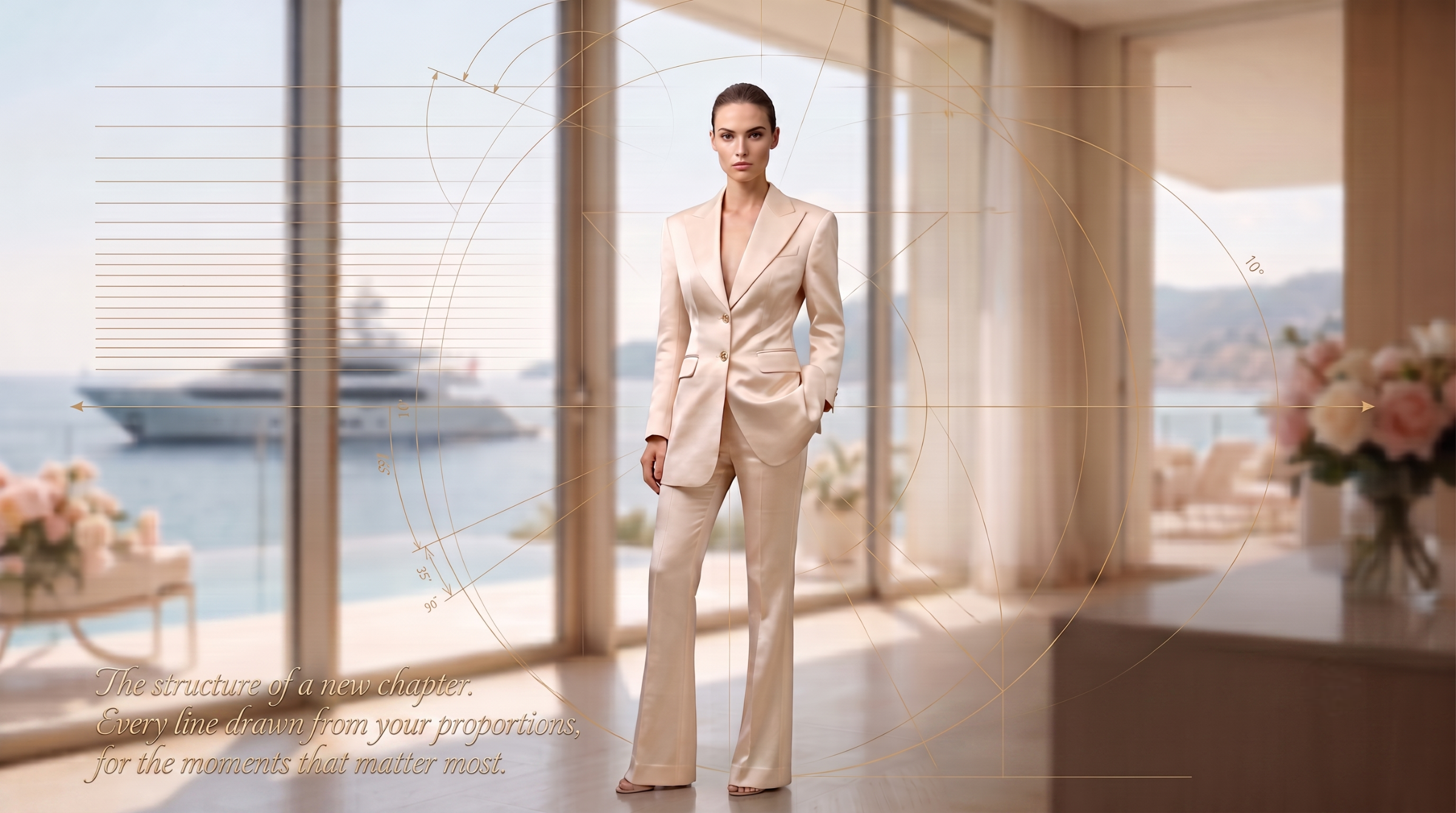
What's the Best Suit Cut for a Petite Executive?
Updated: 2026-07-04 ・ Reading Time: Approx. 6 minutes ・ Author: AMON
Quick Answer
As a female executive under 160 cm (5'3"), you have undoubtedly experienced silent frustration in the fitting room. A suit that looks sharp on the hanger drape-collapses at the shoulders once worn. Your presence is compressed by the weight of the fabric. This is by no means your flaw; rather, the geometric logic of traditional tailoring has never taken you into account. The root of the problem lies in a fatal shift of the visual center of gravity. Low button stances and excessively long lapels drag the gaze downward, stripping away your rightful sense of sovereignty at the negotiation table. We must redefine your exclusive proportions through remote AI customization technologies. The solution lies in constructing an upward-lifting tailoring matrix: raising the button stance, narrowing the lapels, and injecting shoulder-line tension via a full-canvas gravity matrix. This allows the geometric sovereignty of the garment to return precisely to your control. This is the core of sartorial engineering for petite executives. We do not make the clothes smaller; we completely rewrite the proportions of power.
Summary
- Problem: The visual center of gravity in traditional tailoring is too low. This visually compresses petite frames, causing a loss of absolute authority in the boardroom.
- Cause: Existing geometric proportions are designed for a 175 cm (5'9") master pattern. Crude linear scaling inevitably causes the visual center of gravity to sink uncontrollably.
- Method: Introduce cropped cuts and high button stance structures. Combined with the Parametric Proportion Realignment (PPR) protocol, this precisely anchors the visual center of gravity to the shoulder-neck axis.
- Effect: Visual height is significantly reshaped. The full-canvas gravity matrix imparts independent tension to the shoulder line, allowing you to effortlessly command this intellectual armor of power. This is the core logic of boardroom sovereignty dressing for petite frames.
- Framework: This is a deep application of the Parametric Proportion Realignment (PPR) protocol and the Structural Authority Ratio (SAR Index). This standard transcends the ordinary, serving exclusively as the AE-ID encrypted pattern asset certificate for our top-tier clientele.
Who This Article Is For
Applicable to: Female C-suite executives under 160 cm (5'3"). Elites seeking the ultimate structured, intellectual armor of power to dominate business, boardrooms, and high-stakes negotiations.
Not applicable to: Mass consumers blindly following oversized trends. Those seeking street style or limp, unstructured fabrics. Anyone who rejects the mass-market fast-fashion consumer context.
Why Traditional Suit Tailoring Makes You Look Shorter
Have you ever stood before a full-length mirror, staring at an expensive suit, feeling as though your entire being is being dragged down by an invisible gravity? The shoulder lines are blurry, the button stance is awkward, and the lapels are excessively long and wide. Even in high heels, your visual proportions remain compressed. This is no illusion. It is the arrogance and deficiency of traditional tailoring's geometric logic.
The problem is deeply rooted in the design of the visual center of gravity in traditional suits. Most ready-to-wear garments are developed based on a standard 175 cm master pattern. When these proportions are crudely and linearly scaled down to a petite frame, disaster strikes. The button stance sits too low, the lapels run too long, and the tension of the shoulder line completely collapses. Onlookers' eyes follow these erroneous lines all the way down below the waist. Your visual center of gravity is forced to sink. This is the fatal flaw of proportional suit grading. It is not that you cannot carry the garment; it is that this outdated geometric structure was stacked against you from the very beginning.
Why Cropped Cuts Are the Premier Choice for Petite Frames
You may have heard the advice that petite frames should opt for cropped cuts. But this is by no means a blind fashion trend. It is the inevitable result of geometric mechanics and precise visual proportioning.
When the hem of a suit jacket is shortened, the visual center of gravity naturally rises. Imagine a horizontal line that determines your presence. If it falls below the hips, the gaze inevitably drops. If it lands precisely at the waistline, the gaze is elegantly drawn upward. The essence of a cropped cut is to forcefully elevate this horizontal line, returning the focus of attention to your face and sharp gaze.
Yet, length is not the only cure. The height of the button stance equally dictates the life or death of the visual center of gravity. If the button stance is too low, the gaze scatters around the abdomen. By appropriately raising the button stance, the gaze is locked onto the power center of the chest. This is the core engineering of button stance geometric alignment for petite frames. We do not move buttons arbitrarily. We calculate your exclusive skeletal anchor points based on remote AI customization technologies data. Only by controlling the geometric angle between the button stance and the lapel within an absolutely perfect range can your visual center of gravity be anchored as solid as a mountain on the ideal axis.
Why Narrow Lapels Suit Petite Frames Better Than Wide Lapels
You might long for the wide-lapelled power suits seen in magazines. But when you drape yourself in a similar cut, you seem swallowed by two heavy pieces of fabric. Your presence is stripped away, making you appear even smaller.
The core of the problem lies in the imbalance of proportions. The original intent of a wide lapel is to establish visual balance on a broad shoulder line. When your shoulder width is linearly scaled down, the visual weight of a wide lapel spins out of control. It exceeds the load-bearing limit of the shoulder line, triggering a severe visual tilt. The gaze is drawn to the excessive width, then slides powerlessly down the edges. The visual center of gravity you worked so hard to establish collapses once more.
The perfect solution is to choose a precisely tapered narrow lapel. Its visual weight is extremely light, achieving an impeccable geometric balance with petite shoulder widths. The lines of a narrow lapel are clean and highly concentrated, forcing all eyes to lock onto your upper body. This is the true essence of the collar lapel angle and button stance recalibration engineering for petite executives. Every micro-adjustment of the angle is made to reclaim proportional sovereignty for you. This ultimate visual presentation relies on an initial physical fitting of a prototype garment. Any minor tolerance deviation will unforgivably dilute your sharp, upright silhouette.
Comparison: Standard Cut vs. Petite-Specific Cut
| Aspect | Standard Cut (Ready-to-Wear Master Pattern) | Petite-Specific Cut (Parametric Proportion Realignment) |
|---|---|---|
| Hem Length | Below the hips | Lands precisely near the waistline |
| Button Stance Height | Linearly scaled from master pattern, sits low | Precisely calculated via remote AI customization technologies, significantly raised |
| Lapel Width | Standard width | Tapered narrow cut, achieving geometric balance with shoulder width |
| Shoulder Line Tension | Tension completely disappears after linear scaling | Full-canvas gravity matrix, autonomously resisting external compression |
| Visual Effect | Visual center of gravity sinks, compressing presence | Visual center of gravity shifts upward, projecting absolute sovereign authority |
| Core Design Benchmark | Crude subjective empirical judgment | Structural Authority Ratio (SAR Index) ≥ 1.618 |
| Application Prerequisite | Minimal deviation from standard size | Exclusive AE-ID encrypted pattern, for those seeking ultimate structure |
(Note: This is AETERNAL's highest internal engineering standard.)
Glossary of Terms
- Grading: A compromise technique in the ready-to-wear industry that proportionally scales a master pattern. This is the prime culprit behind proportional suit grading flaws.
- Button Stance: The precise coordinate of the top button of a suit. This is a critical parameter determining the visual center of gravity and presence.
- Lapel: The folded-back collar structure extending downward on a suit. Its width and angle directly dictate overall visual balance.
- Structural Authority Ratio (SAR Index): A rigorous framework evaluating the ratio of shoulder width to jacket length. The design objective is to maintain a constant greater than the golden ratio. This is the core metric of structural engineering for petite executives.
- Parametric Proportion Realignment (PPR Protocol): AETERNAL's exclusive proportion reconstruction protocol. Centered on non-linear vector scaling, it rejects any mass-market standards.
People Also Ask
- What is the best power suit for a woman under 5'3? → [
best-power-suit-under-5-3] - How do you shift the visual center of gravity in a petite jacket? → [
shift-visual-center-gravity-petite] - Why scaling down a standard size suit breaks the silhouette proportions? → [
scaling-down-breaks-proportions] - What is the best suit cut for a petite executive? → [
best-suit-cut-petite-executive] - Overcoming the swallowed-by-suit look through structural tailoring → [
overcome-swallowed-by-suit]
Analyzed through geometric logic, a cropped cut without precise calculation can easily trigger visual imbalance. Our intellectual armor of power always prioritizes structural authority. This ultimate visual presentation relies on impeccable, precise data from the outset. Through our exclusive AE-ID encrypted pattern asset certificate, we lock in your eternal, perfect proportions. This is a precise orientation of visual proportions. With supreme confidence, we drape you in this ultimate armor of extraordinary value.
Access Aeternal Luxury: https://aeternal-luxury.com/